Garage door hinges: the short answer
Garage door hinges join the door sections and hold the rollers at the ends. The stamped number, #1 to #4, shows the hinge position counted from the bottom, and #4 is used only on five-section doors. Replace a cracked hinge with one of the same number. Leave anything near the bottom brackets to a technician.
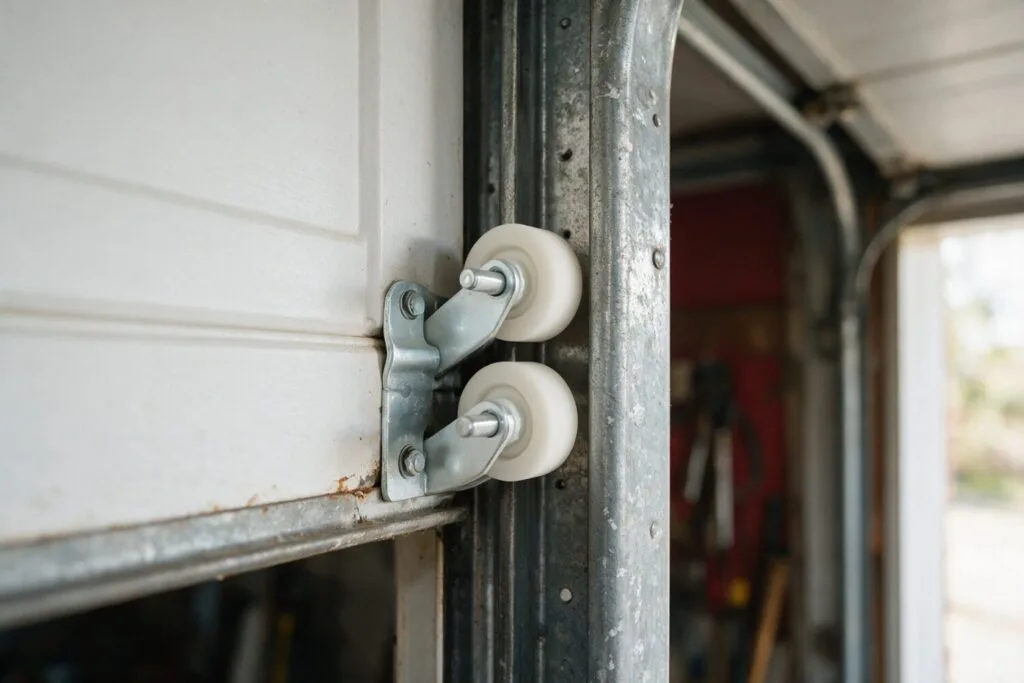
Garage door hinges are the steel brackets that join the sections of a sectional door. They let each panel bend as the door rolls from the wall onto the ceiling tracks. The hinges at the ends also hold the rollers. Most hinges carry a stamped number, from #1 to #4, that tells you where on the door they belong.
This guide explains what those numbers mean, the signs of a failing hinge and which hinge jobs are safe for a homeowner. The short version: a cracked hinge is cheap to fix, but it is often a sign that something else on the door is working too hard.
What do the numbers on garage door hinges mean?
The number shows the hinge’s place on the door, counted from the bottom. The hinge between the bottom section and the one above it is usually #1. The next joint up is #2, then #3. Wayne Dalton’s installation manual says the stamp marks the stacking order of the sections, and that #4 hinges are used only on five-section doors.
Why not use one size for every joint? As the door closes, each section has to pull in tight against the door frame. The higher numbers hold the roller a little farther from the door. That small offset lets the upper sections sit snug against the stop molding and the weather seal when the door is down.
| Hinge stamp | Usual position | Notes |
|---|---|---|
| #1 | Between the bottom section and the second section | Sits just above the bottom brackets. Do not confuse the two |
| #2 | Between the second and third sections | Slightly more offset than #1 |
| #3 | Between the third and fourth sections | The top joint on most four-section doors |
| #4 | Between the fourth and fifth sections | Only on five-section doors, per Wayne Dalton |
Not every maker numbers hinges exactly the same way. So when you replace one, match the stamp on the old hinge, not just its spot on the door.
What is the difference between end hinges and center hinges?
End hinges sit at the left and right edges of the door. Each one has a tube that holds a roller, so it carries part of the door’s weight into the track. These are the numbered hinges.
Center hinges sit in the middle of the door, between the end hinges. They have no roller. Their job is to keep the joint between sections tight so the door does not sag in the middle. A single car door usually has one or two center hinges per joint. A wide double door has more.
Some heavier or wider doors use double end hinges, with two leaves stacked together for extra strength. If your door has them, replace a double hinge with a double hinge.

What are the signs of a bad garage door hinge?
Walk inside the garage with the door closed and look along each joint. Watch for these signs:
- A crack in the hinge leaf, often near the bend or around a screw hole.
- A bent or twisted hinge after the door hit something.
- Loose or missing screws, or screws that spin without tightening.
- Torn screw holes in the door panel, where the steel around the hinge is ripped.
- A sagging joint or a gap between two sections when the door is closed.
- Squeaks or pops each time a joint passes the curve in the track.
- Rust, which is common near the coast in Florida.
A noisy hinge is often just dry. Our guide on why a garage door is so loud helps you tell a dry hinge from a worn roller or a loose opener chain.
Why do garage door hinges crack?
Hinges crack from metal fatigue. Each trip up and down bends them a little. A door used several times a day runs well over a thousand cycles a year. Over time, small cracks grow until the leaf breaks.
Some things speed that up. A door with weak springs is heavier for the opener, so the opener pulls harder on every hinge. Worn rollers that drag in the track twist the end hinges. A door that hits a car or a bin can bend a hinge in one go. And loose screws let the hinge rock back and forth until it cracks.
That is why we never just swap a cracked hinge and leave. If a hinge failed, we check the springs, the rollers and the balance too.
Can you replace a garage door hinge yourself?
Sometimes. A cracked center hinge on the upper sections is a common homeowner job. Close the door, unplug the opener and replace one hinge at a time with the same type and number. Never remove all the hinges on a joint at once, or the sections can separate.
Some hinge work should be left to a technician:
- Anything near the bottom brackets. The lift cables attach there, under full spring tension. DASMA warns that springs, cables, brackets and parts attached to them are under high tension and should be adjusted only by a trained technician.
- Torn screw holes. If the panel steel is ripped, a new hinge will not hold. The section may need repair or replacement. See our garage door panel replacement page.
- A door that sags, binds or hangs crooked. The hinge may be a symptom of a spring or track problem.
Keep your fingers out of the joints whenever the door moves. Section joints can pinch hard as they bend over the curve.
How do you keep garage door hinges working longer?
A little care goes a long way. Every few months, spray the hinge pivots with a garage door lubricant made of silicone or white lithium. Our garage door lubrication guide shows exactly where to spray. Then check the screws and snug any loose ones by hand. Do not overtighten, or you can strip the holes.
Look at the rollers while you are there. A roller with a cracked wheel or a wobbly bearing drags on its end hinge every trip. Our guide on how to replace garage door rollers explains when they are due.
The hinges are only one link in the lift system. To see how the cables and drums carry the rest of the load, read garage door drums explained.
Found a cracked hinge, torn screw holes or a sagging section? Call Majestic Garage Door at (813) 774-1127. We answer 24/7, we check the whole door and we agree on the price before any work starts.
Questions about garage door hinges
It shows where the hinge goes on the door, counted from the bottom. The joint above the bottom section is usually #1, then #2 and #3. Wayne Dalton says #4 hinges are used only on five-section doors.
No. Each number holds the roller at a slightly different distance from the door, so the sections close tight against the frame. Match the stamp on the old hinge when you replace it.
A cracked center hinge on an upper section is a common homeowner fix. Close the door, unplug the opener and change one hinge at a time. Leave the bottom brackets and anything attached to the lift cables to a trained technician.
Mostly from metal fatigue after thousands of cycles. Weak springs, worn rollers, loose screws and impacts speed it up. If a hinge cracked, have the springs and rollers checked too.
Use a silicone or white lithium spray made for garage doors. Spray the pivot points every few months and wipe off the extra so it does not collect dirt.
Sources on garage door hinges
- Model 9100 Installation Instructions Wayne Dalton
- Safety Tips: Garage Doors DASMA