Garage door parts: the short answer
A sectional garage door has about 20 main parts in four groups. The spring system (torsion springs, shaft, cable drums, lift cables and bottom brackets) lifts the door. Tracks, rollers and hinges guide it. Sections, struts and seals form the door itself. The opener adds a motor, rail, trolley, safety sensors and an emergency release. Leave the spring system to a technician.
A garage door has about 20 main parts, and most of them work together to lift a door that can weigh well over 100 pounds. The diagram below names each one, numbered from the springs at the top to the seal at the bottom. Knowing the names helps you describe a problem on the phone, read a quote and tell which jobs are safe to do yourself.
The diagram shows a common sectional door with torsion springs and a ceiling-mounted opener, seen from inside the garage. Doors with side-mounted extension springs are covered further down.
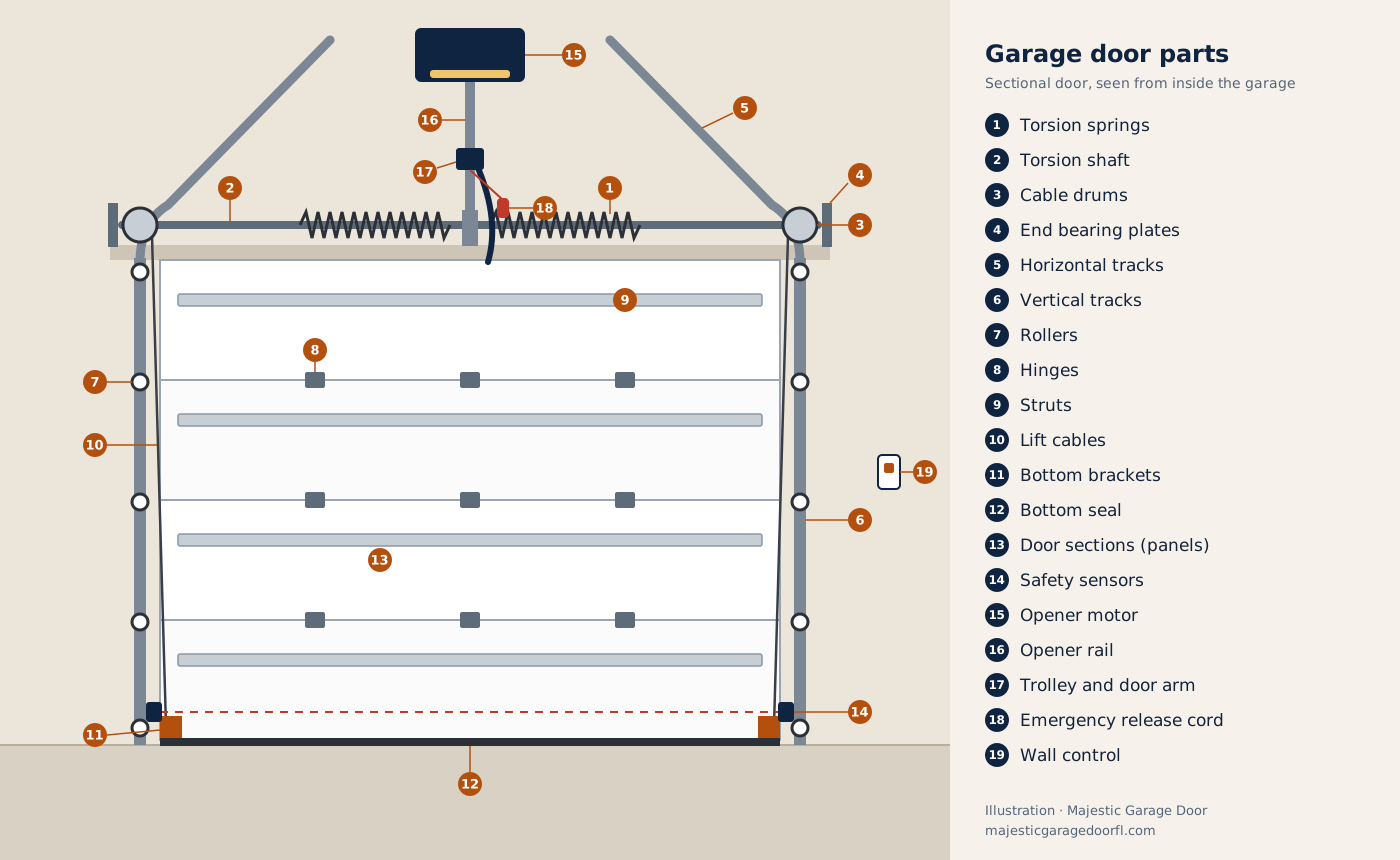
What are the parts of a garage door called?
The table lists every numbered part in the diagram, what it does and the signs that it is wearing out. The last column says whether the part is a homeowner job or one for a trained technician.
| # | Part | What it does | Signs of wear | Who should handle it |
|---|---|---|---|---|
| 1 | Torsion springs | Twist to store the force that lifts the door | A gap in the coil, a loud bang, a door that feels very heavy | Technician |
| 2 | Torsion shaft | Steel tube that carries the spring force to both ends | Wobbling, a bent tube, one side lifting first | Technician |
| 3 | Cable drums | Grooved wheels that wind the lift cables up | Cable jumping the grooves, cracked drum | Technician |
| 4 | End bearing plates | Hold the ends of the shaft on the wall | Grinding, a shaft that sags at one end | Technician |
| 5 | Horizontal tracks | Carry the door back along the ceiling | Sagging, loose hangers, rollers rubbing | Technician for bends, homeowner can tighten loose bolts |
| 6 | Vertical tracks | Guide the door up and down the opening | Dents, gaps between track and door, scraping | Technician |
| 7 | Rollers | Wheels that ride inside the tracks | Squeaking, wobbling, cracked or flat wheels | Technician, except the bottom set is risky for anyone |
| 8 | Hinges | Join the sections so the door can bend around the curve | Cracks, loose screws, rust | Homeowner can tighten, technician to replace |
| 9 | Struts | Steel bars that stiffen the sections | Bowing in the middle of the door | Technician |
| 10 | Lift cables | Connect the drums to the bottom of the door | Fraying, rust, slack on one side | Technician |
| 11 | Bottom brackets | Anchor the cables to the bottom section | Rust, bent metal | Technician only, they are under full tension |
| 12 | Bottom seal | Rubber strip that closes the gap at the floor | Light, water or sand under the door | Homeowner |
| 13 | Door sections | The panels you see from the street | Dents, cracks, rust at the bottom edge | Technician |
| 14 | Safety sensors | Infrared eyes that stop and reverse a closing door | Blinking light, door that will not close | Homeowner can clean and aim them |
| 15 | Opener motor | Drives the door up and down | Humming without moving, clicking, no response | Technician for repairs |
| 16 | Opener rail | Track the trolley runs along | Loose mounting, grinding | Technician |
| 17 | Trolley and door arm | Connect the opener to the top of the door | Jerky motion, a bent arm | Technician |
| 18 | Emergency release cord | Disconnects the door from the opener | Missing handle, frayed cord | Homeowner can use it, with care |
| 19 | Wall control | Button that runs the opener | Dead button, flashing light | Homeowner for batteries, technician for wiring |
Which parts lift the door?
The springs do the lifting, not the opener. Torsion springs sit on the shaft above the door. When the door closes, they twist and store energy. When it opens, they unwind and turn the shaft.
The shaft turns a cable drum at each end. Each drum winds up a lift cable, and the cables pull on the bottom brackets. A center bearing bracket holds the middle of the shaft, and end bearing plates hold its ends. In a well balanced door, these parts carry almost all of the weight. The opener only guides the door.
That is also why this group is the most dangerous. DASMA, the trade group for door makers, warns that springs and their parts can cause injury, and that some parts should be adjusted only by a trained technician. A broken spring is the most common reason a door suddenly will not lift. Our spring repair page shows what to look for.
What are extension springs, and where do they go?
Some doors use extension springs instead of torsion springs. They run above the horizontal tracks on each side and stretch as the door closes. A pulley and cable on each side connect them to the bottom of the door.
Each extension spring should have a safety cable running through its center. The safety cable holds the pieces if a spring snaps. Extension spring doors have the same lift cables and bottom brackets as torsion doors, and the same rule applies: leave them to a technician.
Which parts guide the door?
The tracks, rollers and hinges keep the door moving in a straight line. The vertical tracks run up each side of the opening. They curve at the top into horizontal tracks that hang from the ceiling on metal hangers.
Rollers ride inside the tracks. Each roller sits in a hinge or bracket on the edge of a section. Steel rollers are common on older doors. Nylon rollers run quieter. Worn rollers are a frequent cause of a noisy door, and our roller replacement page explains the options.
Hinges join the sections. They let the door bend as it moves from the vertical track into the curve. Loose hinge screws are one of the few things a homeowner can safely tighten.
When a roller leaves its track, the whole door can hang crooked and jam. That is a job for our off track repair team, not a pry bar.
What do the struts and sections do?
The sections are the panels that make up the door. Most residential doors have four or five. They can be steel, aluminum, wood or composite. The bottom section takes the most abuse from water, sand and salt, so rust usually starts there.
Struts are steel bars bolted across the back of the sections. They stiffen the door and stop it from bowing. On a wind rated door, they are part of what the door was tested with.
That matters in Florida. A DASMA sheet on component substitution warns that swapping in parts that are not identical can weaken a wind rated door. It can even void the door’s certification. Replacement struts, hinges and brackets on a rated door should match what the maker specifies.
What are the parts of a garage door opener?
A garage door opener has five main parts. The motor unit hangs from the ceiling. The rail runs from the motor to a bracket above the door. A trolley rides along the rail, and a door arm links the trolley to the top section.
The emergency release cord hangs from the trolley. Pulling it disconnects the door from the opener, so you can move the door by hand. Use it only when the door is fully closed, because a door with a broken spring can drop fast.
The safety sensors sit a few inches above the floor on each side of the opening. They send an invisible beam across the doorway. If something breaks the beam, the door stops and reverses. Federal rule 16 CFR Part 1211 requires this kind of entrapment protection on residential openers made since 1993.
Some openers mount on the wall beside the door and turn the torsion shaft directly. They have no rail or trolley. Remotes and keypads talk to the motor unit, most of them using rolling code security. For a motor that hums, clicks or will not respond, see our opener repair page.
Which seals keep water and sand out?
A garage door has three seals. The bottom seal is a rubber strip held in a metal or vinyl retainer on the bottom section. The perimeter seal runs up both sides and across the top of the frame. Some doors also have seals between the sections.
Seals wear faster in Florida sun and rain. Daylight, water or sand under the door means the bottom seal is due. It is one of the easier parts for a homeowner to replace.
Which parts can you replace yourself?
A few parts are fair game for a careful homeowner. You can replace the bottom seal, clean and aim the safety sensors, change batteries in the remotes and tighten loose hinge or track bolts. You can also lubricate hinges, rollers and springs as the door maker directs.
Leave the spring system alone. That means the springs, shaft, drums, end bearing plates, lift cables and bottom brackets. The U.S. Consumer Product Safety Commission’s garage door safety sheet notes that an unbalanced door could crash to the floor. It advises having such a door serviced by a professional.
Not sure which part is failing? Call Majestic Garage Door at (813) 774-1127. We answer 24/7, check the whole door and agree on the price with you before any work starts.
Questions about garage door parts
The spring system. Torsion and extension springs store a lot of force, and the lift cables and bottom brackets are under that same tension. DASMA warns that springs can cause injury and that some parts should be adjusted only by a trained technician. Never loosen a bottom bracket or a set screw on a spring.
The springs. They balance the weight of the door so it feels light. The opener only moves a door that the springs already hold. If a spring breaks, the door can become too heavy to lift, and the opener may strain or stop.
Most torsion spring doors have one or two springs on the shaft above the door. Heavier or wider doors usually have two. Extension spring doors have one spring on each side, above the horizontal tracks, with a safety cable through each.
They are called rollers. Each roller sits in a hinge or bracket on the edge of a door section and rides inside the track. Rollers come in steel and nylon. Worn rollers often make a door noisy or shaky.
Some parts, yes. A bottom seal, remote batteries or loose bolts are fair homeowner jobs. Springs, cables, drums and bottom brackets are not. On a wind rated door, DASMA warns that parts that are not identical can weaken the door and void its rating.
Sources on garage door parts diagram
- Garage Door Systems Safety Tips DASMA
- Component Substitution on Wind Load Rated Doors (TDS 183) DASMA
- 16 CFR Part 1211: Safety Standard for Automatic Residential Garage Door Operators Electronic Code of Federal Regulations
- Non-Reversing Automatic Garage Door Openers Are a Hazard (Pub. 523) U.S. Consumer Product Safety Commission
- Torsion spring Wikipedia
- Garage door opener Wikipedia